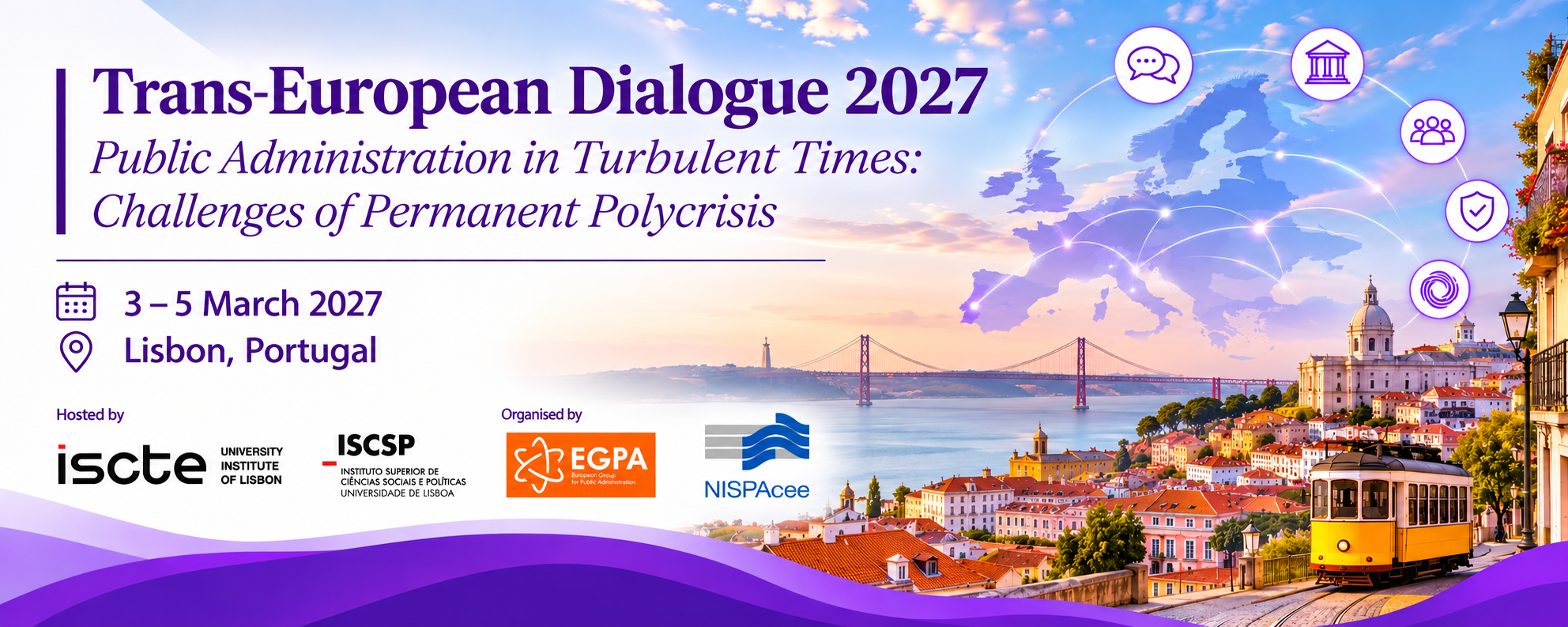
The Trans-European Dialogue (TED) is a scholarly and professional forum organised jointly by the European Group for Public Administration (EGPA) and the Network of Institutes and Schools of Public Administration in Central and Eastern Europe (NISPAcee). It brings together academics, senior practitioners and public administration experts from different European administrative traditions to debate the major challenges facing governments and public institutions.
Why this theme?
European public administrations increasingly operate in conditions where disruption is the norm rather than the exception. Geopolitical instability, fiscal pressures, populism, war, demographic change, migration, climate risks, artificial intelligence and declining institutional trust overlap and reinforce one another. Governments are no longer facing isolated crises, but persistent and interconnected turbulence.
This raises a fundamental question for Public Administration:
How can public institutions remain capable, resilient and legitimate when turbulence becomes a normal condition of governing?
What will TED 2027 explore?
TED 2027 invites scholars and practitioners to examine how public administrations respond to these conditions and how their capacities can be strengthened. It also looks at which forms of governance allow governments to anticipate, learn and adapt, rather than simply react, while preserving democratic legitimacy and public value. Particular attention will be given to comparative perspectives across European administrative systems, including the differences and commonalities between Western, Central and Eastern European experiences.
Thematic Dialogues
Contributions are invited around five interconnected areas:
How do permanent and overlapping crises affect the capacity of public institutions to govern?
Possible questions include:
Which administrative capacities matter most under sustained turbulence?
How can governments reconcile resilience with adaptation and innovation?
What distinguishes robust institutions from institutions that merely absorb short-term shocks?
How do institutional structures and administrative traditions shape responses to polycrisis?
What can European countries learn from comparative experiences of crisis governance?
Polycrisis places Public Administration organizations, welfare systems, public finances and existing models of redistribution under increasing strain.
We invite contributions examining:
Public Organization configurations;
Fiscal sustainability and changing demands on the state;
Demographic ageing and workforce pressures;
Migration and integration;
Territorial and social inequalities;
Welfare-state adaptation;
Changing expectations concerning public intervention;
Tensions between short-term crisis responses and long-term sustainability.
Periods of turbulence compress decision-making time while increasing uncertainty and interdependence.
Relevant questions include:
How does uncertainty affect policy formulation and implementation?
How can governments coordinate across ministries, levels of government and organisational boundaries?
What happens to policy implementation when priorities change rapidly?
How can governments and PA combine agility with accountability?
What PA institutional arrangements support anticipatory and adaptive policymaking?
Governments need not only to respond but also to learn.
TED 2027 welcomes research and practice addressing:
Organisational and policy learning;
Evidence-informed policymaking;
Strategic foresight and anticipatory governance;
Performance management in unstable environments;
Data and analytical capacity;
Institutional memory;
The translation of individual expertise into organisational capability.
Particular attention is welcome on why governments sometimes fail to learn even when evidence and experience are available.
Administrative capacity cannot be separated from legitimacy.
This Dialogue will consider:
Trust in government and public institutions;
Accountability under crisis conditions;
Politicisation and professionalisation;
Democratic backsliding and administrative resilience;
Integrity and public values;
Digital government and artificial intelligence;
Algorithmic decision-making and administrative discretion;
Transparency, rights and legitimacy in increasingly data-driven administrations.
Contributions examining how technological transformation interacts with democratic institutions and public-sector values are particularly encouraged as well as dialogues between theory and practice.