- News
- Events
- Recurring Events
- Biographies and Trajectories
- Cidades & Impérios: dinâmicas locais, fluxos globais
- Cultural Diversity in Contemporary Families
- Meetings on China Studies
- Meetings Migration Experiences
- Social studies on science and the circulation of knowledge
- Public Policy Forum
- Research Forum CIES
- Gender, Sexuality and other social markers of difference
- Language, Power, and Social Boundaries
- ETNO.URB Readings
- Social Movements and Political Action
- New Perspectives on Modern History
- Revisiting the 19th Century
- Research Workshops
- Methodological Innovation Workshops
- Calls
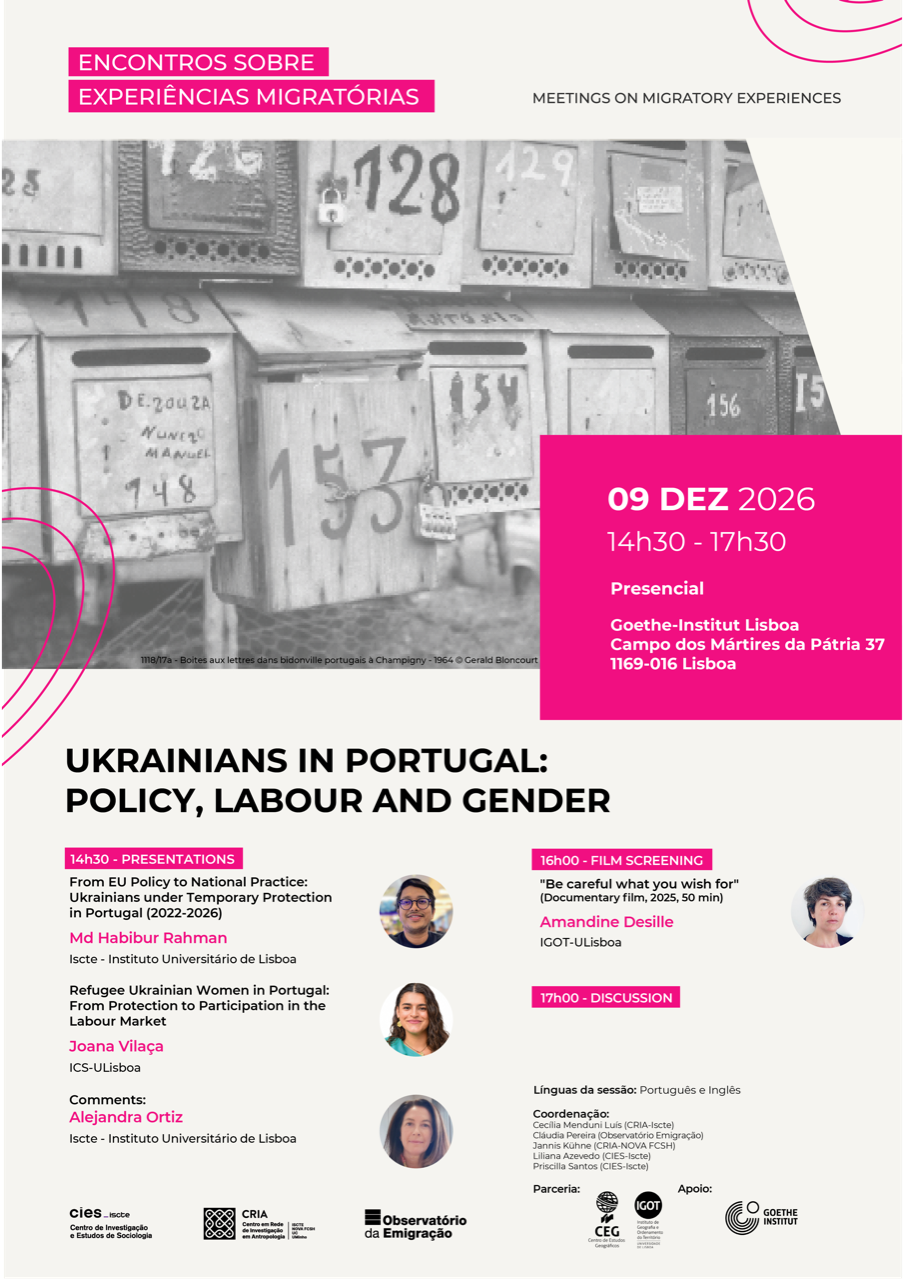
DATE
9 December 2026
TIME
2.30 pm
VENUE
Goethe-Institut Lisbon | Campo dos Mártires da Pátria, 37, 1169-016 Lisbon
Programme
2.30 pm Presentations
From EU policy to national practice: Ukrainians under temporary protection in Portugal (2022–2026)
Md Habibur Rahman, Iscte
Ukrainian women refugees in Portugal: from protection to participation in the labour market
Joana Vilaça Silva, ICS-ULisboa
4.00 pm Film screening
‘Be careful what you wish for’ (50 mins)
Amandine Desille, IGOT-ULisboa
5.00 pm Discussion
Abstracts
From EU Policy to National Practice: Ukrainians under Temporary Protection in Portugal (2022-2026)
The activation of the EU Temporary Protection Directive (TPD) in March 2022 following Russia's full-scale invasion of Ukraine introduced an exceptional framework for providing immediate protection to people displaced by the war. While the Directive established a common European framework of rights, its implementation depended on national institutional arrangements, public service capacity and cooperation between state and non-state actors. This article examines the evolution of Portugal's governance response to displaced Ukrainians between 2022 and 2026, focusing on three interconnected dimensions: the mainstreaming of temporary protection beneficiaries into existing public services; the changing relationship between state institutions, municipalities and civil society organisations; and the institutional and legal adaptation of temporary protection to prolonged displacement.
Drawing on a qualitative longitudinal case-study design, the research combines legal and policy document analysis of institutional and civil society reports. The analysis is guided by three complementary perspectives: public service mainstreaming, multi-level and collaborative governance, and institutional adaptation over time. Using the EU TPD as a normative baseline, the analysis indicates that Portugal’s response combined rapid formal inclusion in existing public systems with mobilisation of civil-society and community support. However, the translation of formal entitlements into effective access was uneven.
In this presentation, I argue that Portugal’s experience reveals a tension between rights-based mainstreaming and the operational capacity needed to sustain it. Through this analysis, I contribute to debates on European migration governance by showing that prolonged temporary protection depends not only on legal continuity, but also on durable coordination, accessible public services and monitoring.
Refugee Ukrainian Women in Portugal: From Protection to Participation in the Labour Market
This presentation examines the labour market integration trajectories of Ukrainian refugee women who sought protection in Portugal following Russia’s full-scale invasion of Ukraine in 2022. Although the European Union’s Temporary Protection Directive has facilitated rapid access to legal status and employment rights, formal protection does not necessarily translate into meaningful socio-economic integration. Against this backdrop, the presentation explores how Ukrainian refugee women navigate the transition from temporary protection to labour market participation, focusing on the structural, gendered and institutional factors shaping their experiences.
Drawing on nineteen semi-structured interviews, the research adopts a qualitative approach to explore women's experiences, challenges and pathways into the Portuguese labour market. The analysis highlights the role of language barriers, limited access to affordable childcare and labour market segmentation in shaping employment opportunities and integration processes. These challenges reveal how gendered care responsibilities and structural constraints can limit women's access to stable employment and their ability to make use of previous professional qualifications and experience.
The findings demonstrate that labour market integration is neither linear nor guaranteed, but rather a fragmented and stratified process, characterised by unequal opportunities and differentiated trajectories. This presentation contributes to discussions on forced migration, gender and labour market integration by highlighting the gap between formal access to employment and substantive socio-economic inclusion. It argues that, while temporary protection is an essential mechanism of immediate protection, meaningful integration requires addressing the structural and institutional inequalities that continue to shape refugee women's participation in the labour market.
“Be careful what you wish for”
Documentary film (50min)
Synopsis: In this film, we follow three Ukrainian women in Lisbon in the weeks after the war in Ukraine begins. Moving from scenes of grassroots solidarity to the intimate textures of diasporic life, the film explores how Ukrainianness is reproduced far from home—through art, language, and family. Woven throughout is the filmmaker’s own voice, grappling with the ethics of representation in times of crisis, and searching for nuance beyond dominant narratives of victimhood and villainy.
Languages: Ukrainian, Russian, Portuguese, English and French | Subtitles: English | Team: Amandine Desille (screenwriting, image, sound and edition) and Lucia Andujar (edition) | Production: IGOT, University of Lisbon
Trailer: https://vimeo.com/846571865?share=copy
Amandine Desille is a geographer at the Institute of Geography and Spatial Planning, University of Lisbon. Her main research interests are migration governance and place-making, cultural heritage, and visual and sensory methodologies. She mainly works in non-metropolitan areas in the Mediterranean region. She has filmed four films, and is also an active member of non-profit organisations and collectives dedicated to urban and diversity matters through creative participatory work.
Joana Vilaça Silva is a PhD candidate in the Migration Studies programme at the Institute of Social Sciences of the University of Lisbon (ICS-ULisboa), specialising in the Sociology of Inequalities, Minorities, and Social Movements. She holds a master’s degree in international economics and management from the Faculty of Economics of the University of Porto, completed in 2020, and a bachelor’s degree in economics from the University of Minho, obtained in 2017. Her research interests lie at the intersection of migration, economic structures, labour markets, gender relations, and social inequalities. She explores how economic conditions, labour market dynamics, and gender shape migration trajectories and opportunities, as well as the experiences of minority groups.
Md Habibur Rahman is a PhD researcher in International Studies and an FCT doctoral fellow at the Centre for Research and Studies in Sociology at Iscte - University Institute of Lisbon, Portugal. His doctoral research entitled, “Protection 2 Integration (P2I): Portuguese Policy Response for the Integration of Ukrainian Refugees into the Labour Market” focuses on national policy frameworks and labor market integration processes for displaced Ukrainians in Portugal.