- News
- Events
- Recurring Events
- Biographies and Trajectories
- Cidades & Impérios: dinâmicas locais, fluxos globais
- Cultural Diversity in Contemporary Families
- Meetings on China Studies
- Meetings Migration Experiences
- Social studies on science and the circulation of knowledge
- Public Policy Forum
- Research Forum CIES
- Gender, Sexuality and other social markers of difference
- Language, Power, and Social Boundaries
- ETNO.URB Readings
- Social Movements and Political Action
- New Perspectives on Modern History
- Revisiting the 19th Century
- Research Workshops
- Methodological Innovation Workshops
- Calls
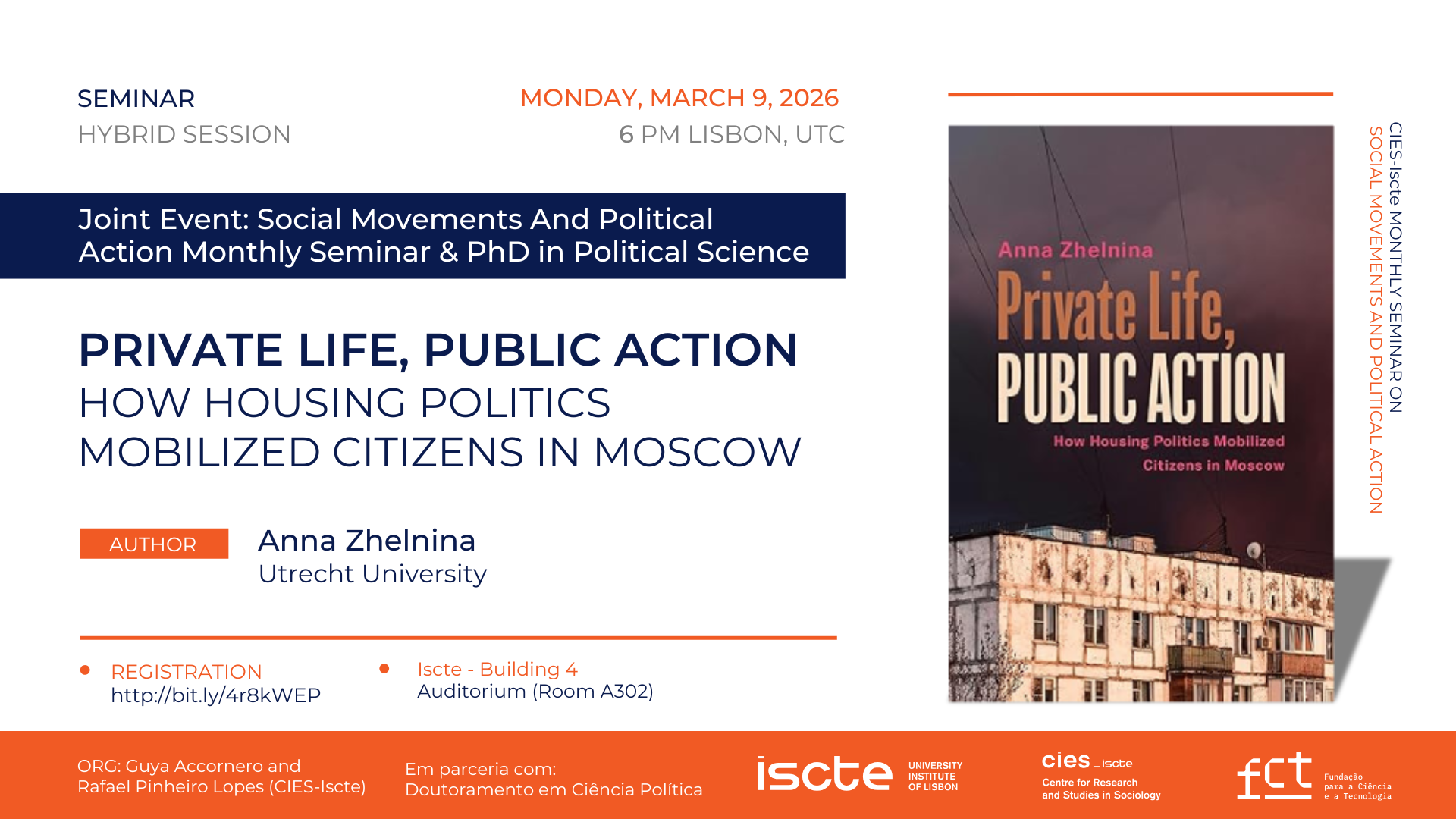
As part of the Monthly Cycle of Seminars Social Movements and Political Action, the seminar "Private Life, Public Action: How Housing Politics Mobilized Citizens in Moscow" will take place on March 9, 2026, at 6:00 p.m., at Iscte – University Institute of Lisbon, in a hybrid format.
VENUE
Romm A202, Building 4
SPEAKER
Anna Zhelnina, Utrecht University
ZOOM LINK
http://bit.ly/4r8kWEP
This session will be held in partnership with the PhD Program in Political Science.
ABSTRACT
Renovation, an urban renewal plan in Moscow that was announced in the spring of 2017, proposed to demolish thousands of socialist-era apartment buildings. In a country where it is rare under an authoritarian government, residents supported or opposed the redevelopment by mobilizing and organizing into local alliances. They were often shocked by their neighbors who were excited about the new housing or those suspicious of being displaced.Private Life, Public Action traces how residents impacted by the relocation plan became activists despite having little to no experience organizing or even forming political affiliations and opinions. Author Anna Zhelnina details the ways in which neighbors engaged in collective action, as well as the individual and structural changes these interactions caused. Zhelnina develops the concept of “housing strategies” to explain how residents’ debates with their neighbors about housing were shaped by their private life strategies. She applies her findings about housing in Moscow to ongoing questions about political mobilization, demonstrating how public engagement is shaped by historical and social contexts.